Table of Contents
Week 1 | KS3 Physics
Day 2 | Energy transfer heating
Day 3 | Conservation of energy
Day 5 | Generating electricity
Week 2 | KS3 Physics
Day 1 | The cost of electricity
Day 2 | Comparing power ratings energy values
Day 5 | Movement of particleswere
Week 3 | KS3 Physics
Day 4 | Friction and resistance
Week 4| KS3 Physics
Week 5| KS3 Physics
Day 1 | Reflection and refraction
Week 6| KS3 Physics
Day 3 | Measuring current and-potential difference
Day 4 | Series parallel circuits
Week 7| KS3 Physics
Day 5 | Day and night and the four seasons
Revision
Physical Changes
There are three states of matter which a substance can be in: a solid, liquid or a gas. If as substance changes between these states, its mass doesn’t change.
Physical and chemical changes are different as in a physical change there is no actual reaction, so no new substances are made. The particles stay the same just a different arrangement and amount of energy.
How to change the physical state of a substance?
1. MELTING, EVAPORATING, CONDENSING AND FREEZING:
- Melt a certain amount of ice = same amount of water = boil it so it evaporates = same amount of steam
- Same in the other direction: steam condenses = same amount of water = water freezes = same amount of ice.
2. SUBLIMATION:
- Going straight from a solid to a gas. A substance that can do this is carbon dioxide.
- Mass of gas= mass of solid
3. DISSOLVING:
- There is no change in mass when a solid substance dissolves to form a solution.
- Amount of substance before = amount of substance after
- Dissolving is reversible. This means if you evaporate a solution you are left with the same amount of solid before it was dissolved.
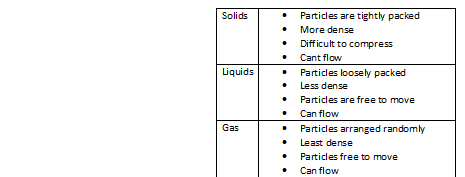
Changing states affects the physical properties of substances.
Heat a substance = particles move around more so are further apart = changes state = substance expands = less dense.
An exception is ice, which becomes denser as particles come close together when it melts to water.
How long have you…? (present perfect 4) Exercises
 Use the information given to create questions beginning with ‘How long…?’
• It is snowing.
• The weather is shining.
• John and Kate are married.
• My brother has gone on holiday.
• My aunty and uncle live in Canada.
• My sister is a teacher.
• I work at the chemist.
• I’ve known Susan since I was a baby.
• Jonathan is learning to speak to Mandarin.
Fill in the missing gaps in the sentences using the present perfect (=has/have + past participle)
• I have known Kate a long time.
• My brother has been playing the piano he was 11 years old.
• My mum and dad on holiday to America. They
gone since last Sunday.
• I Ben and Emma since primary school.
We to the same primary and secondary school.
• My sister learning to speak French because she
is going to France next month.
[bg_collapse view=”link” color=”#fafafa” expand_text=”Reveal Answer” collapse_text=”Hide Answer” inline_css=”background: #2ea3f2; padding: 9px; font-size: 14px; font-weight: 600;” ][/bg_collapse]
Use the appropriate words in the missing gaps. have you lived lives to
has been works have known
I have bought have worked.
• My sister in Spain. She is studying Spanish
with her friend Rosie. I Rosie since I was 5.
• Spencer like with Jamie. They have worked
together for 2 years.
• How long in Australia?
• a new dress for prom.
• He to Thorpe park.
[bg_collapse view=”link” color=”#fafafa” expand_text=”Reveal Answer” collapse_text=”Hide Answer” inline_css=”background: #2ea3f2; padding: 9px; font-size: 14px; font-weight: 600;” ][/bg_collapse]
Challenge: Create 4 of your own questions beginning with ‘How long……?’
1.
2.
3.
4.