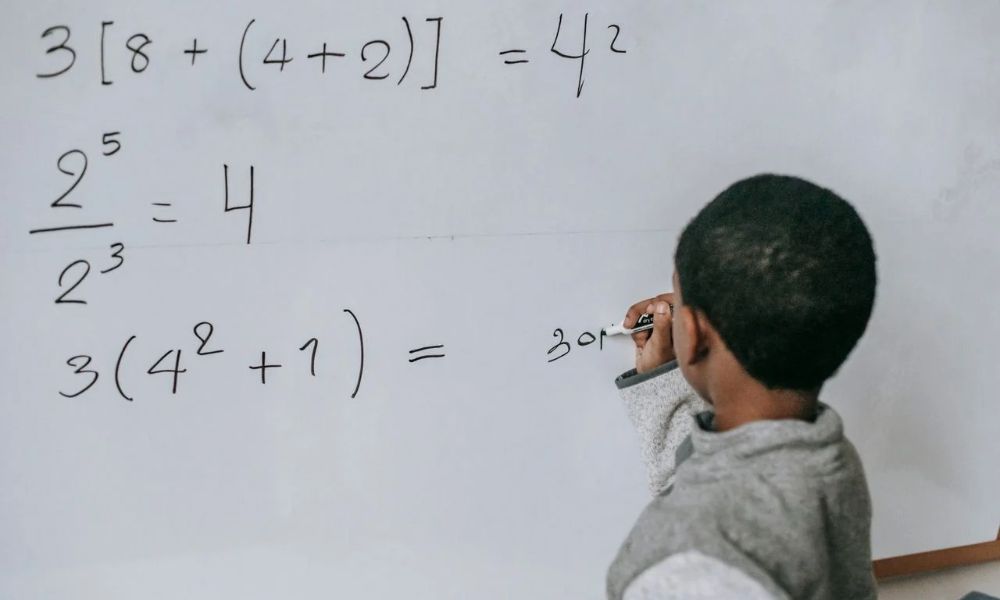
A child follows every step while the teacher explains, then opens their homework and cannot begin. The difficulty may involve recalling a method, choosing it independently or understanding a step that classroom support helped them complete.
Imagine a Year 8 pupil watching their teacher solve an algebra question:
3x + 7 = 22
The teacher asks, “What do we need to do first?”
“Subtract seven,” the pupil replies.
“And then?”
“Divide by three.”
The answer is correct: x = 5.
Later, the pupil opens their homework and finds another equation:
4x + 9 = 41
They stare at the question.
“I understood it in class,” they tell their parent. “But I don’t know where to start.”
For a parent considering maths tuition in Batley, this contrast can be confusing. Their child appeared to follow the lesson but cannot begin a similar question independently.
The difficulty does not necessarily mean the teaching was poor or that the child was not paying attention.
It raises a more useful question:
What could the pupil do with support, and what can they do without it?
Why Can Children Understand Maths in Class but Struggle at Home?
During a lesson, pupils receive more support than they may realise.
The teacher introduces the topic, demonstrates a method and explains the calculations. Questions often follow a recognisable pattern, allowing pupils to connect each exercise with the example they have just seen.
At home, some of those supports may be reduced or unavailable.
The pupil must read the question, recognise the relevant mathematical ideas, choose a method, complete the calculation and check the result.
These are related but distinct demands.
One pupil may understand the method but struggle to recall it. Another may remember the steps but fail to recognise when they apply. A third may choose the correct method but make errors in the calculation.
Some pupils may also find it difficult to interpret written instructions or keep several steps in mind.
A blank homework page cannot establish which of these difficulties is responsible.
That is why a useful response begins with investigation rather than assumptions.
Following an Explanation Is Not the Same as Solving Independently
When a teacher demonstrates a worked example, several decisions have already been made.
The teacher has identified the mathematical topic, selected an appropriate method and arranged the steps in a logical sequence.
The pupil can follow the reasoning and recognise that each calculation makes sense.
This is a valuable part of learning.
However, independent problem-solving places an additional demand on the pupil: deciding what to do before anyone has demonstrated the answer.
Consider the difference between these two questions:
- Question A: “What do we subtract from both sides?”
- Question B: “How would you begin solving this equation?”
Question A tells the pupil that subtraction is required.
Question B leaves the pupil to choose the operation.
Both questions can be useful during teaching, but they provide different evidence of understanding.
A pupil who answers Question A correctly may still need help with Question B.
Equally, a pupil who struggles to explain their reasoning verbally may be able to demonstrate understanding through written working or a diagram.
The important point is to examine what the pupil can actually do, rather than relying on a single answer.
How Can a Tutor Move a Pupil Towards Independence?
Consider a four-stage approach using algebraic equations.
Stage 1: Explain and demonstrate
Begin with:
3x + 7 = 22
We want to find the value of x.
The expression 3x means three multiplied by x. Seven has then been added.
To isolate 3x, subtract seven from both sides:
3x + 7 − 7 = 22 − 7
3x = 15
Now divide both sides by three:
x = 5
Check by substituting five into the original equation:
3 × 5 + 7 = 22
15 + 7 = 22
The answer is correct.
At this stage, the tutor explains not only what to do but why the operations preserve the equality.
Stage 2: Practise with fewer prompts
Now consider:
4x + 9 = 41
Instead of telling the pupil to subtract nine, ask:
- “What are we trying to find?”
- “What operations have been applied to x?”
- “How could we reverse those operations?”
Check whether the pupil can reach:
4x = 32
x = 8
Notice whether they need help selecting the first operation, carrying out the arithmetic or explaining why the method works.
These observations help identify what to teach next.
Stage 3: Attempt a question independently
Present a different equation:
5x − 6 = 29
This time, the pupil must recognise that the first step involves addition rather than subtraction.
Adding six to both sides gives:
5x = 35
Dividing by five gives:
x = 7
Check:
5 × 7 − 6 = 29
35 − 6 = 29
The pupil should be encouraged to complete the calculation and check it without being directed through each step.
If they become stuck, the tutor can provide an appropriate hint and record where the difficulty occurred.
Stage 4: Check learning later
A correct answer immediately after an explanation is encouraging, but it does not establish that the learning has been retained.
Return to equations in a later lesson, alongside questions from other topics.
For example:
7x + 4 = 46
Subtract four:
7x = 42
Divide by seven:
x = 6
- Can the pupil recognise the method without being told that the exercise concerns solving equations?
- Can they explain why their operations are appropriate?
- Can they solve another question with a different structure?
Success across several opportunities provides stronger evidence of learning than one correct answer.
The aim is to develop understanding, accuracy, recall and independent method selection.
Why Does Homework Reveal Difficulties That Classwork May Hide?
Homework changes the conditions under which pupils work.
In class, a teacher may provide reminders, demonstrations, feedback or additional explanations.
At home, some of that support may be unavailable.
The pupil must make more decisions independently.
However, struggling with homework does not automatically mean that the pupil failed to understand the lesson.
The difficulty may involve recalling a method, interpreting the question, selecting an appropriate strategy or completing a calculation accurately.
Parents can begin by asking:
“Show me the last part you understand.”
This question can reveal more than simply asking whether the child knows how to complete the exercise.
For example, a pupil may explain what the question is asking but be unsure which method to use.
Another may identify the method correctly but struggle with multiplication or division.
A third may complete the calculation but be unable to explain why the answer makes sense.
Each situation suggests a different teaching need.
The objective is to identify where independent work breaks down.
What Does Educational Research Tell Us?
The Education Endowment Foundation (EEF) provides guidance on improving mathematics teaching in Key Stages 2 and 3.
Its recommendations include using assessment to build on pupils’ existing knowledge and understanding, and developing pupils’ independence and motivation.
The EEF’s guidance on metacognition and self-regulated learning also emphasises explicitly teaching pupils how to plan, monitor and evaluate their learning.
These skills should be developed through the subject being taught rather than treated as general thinking exercises.
For example, when solving an algebraic equation, a tutor might demonstrate how to:
- Identify what the question requires.
- Recognise the operations applied to the unknown.
- Choose suitable inverse operations.
- Keep both sides of the equation equal.
- Substitute the answer to check whether it is correct.
The tutor may initially explain this reasoning aloud while demonstrating a worked example.
Next, the pupil attempts a similar question with some support.
As the pupil develops greater competence, the tutor adjusts the amount of assistance.
This temporary support is often called scaffolding.
It can include worked examples, partially completed solutions, questions, diagrams and feedback.
The purpose is not to remove help as quickly as possible.
It is to provide appropriate assistance while developing the pupil’s ability to complete the task independently.
Removing support too early may leave a pupil confused. Continuing to provide unnecessary prompts may make it harder to judge what the pupil can do alone.
Effective teaching requires attention to both.
The EEF guidance offers useful principles for this process, although it does not establish that any particular tuition provider will achieve a specific outcome.
When Does More Practice Help—and When Is Different Teaching Needed?
Practice is an important part of learning mathematics.
Repeated calculations can strengthen accuracy, fluency and recall.
However, practice should address the difficulty the pupil is experiencing.
Imagine a pupil completing twenty equations immediately after watching a worked example.
The questions all follow a similar structure:
3x + 4 = 19
5x + 2 = 27
6x + 7 = 43
The pupil may recognise the pattern and become increasingly accurate.
That is useful progress.
However, it does not necessarily establish whether they can select the same method when equations appear alongside other mathematical topics.
Later, a mixed exercise might include fractions, percentages, equations and ratio questions.
The pupil must first decide which mathematical ideas are relevant.
This introduces a different challenge.
Mixed practice can help reveal whether pupils recognise when to apply their knowledge, but it should be introduced at an appropriate stage.
A pupil who has not yet understood the basic method may need further explanation and focused practice first.
A pupil who understands the method but struggles with arithmetic may benefit from improving calculation fluency.
Another pupil may need opportunities to select methods without being told which topic is being tested.
More practice is useful when it addresses the reason the pupil is struggling.
Maths Tuition in Batley: Why Assessment Matters
Two pupils may produce the same incorrect answer but need different support.
One may misunderstand the question.
Another may understand the mathematical concept but forget the method.
A third may choose the correct method and then make a calculation error.
Giving all three pupils identical exercises may not address their individual difficulties.
At Improve Tuition , established in 2007, teaching focuses on identifying learning gaps and helping pupils develop the knowledge and confidence needed to work through mathematical problems.
Parents exploring maths tuition in Batley should ask how tutors assess independent understanding rather than relying only on correct answers during guided practice.
A useful assessment can compare what a pupil does after a demonstration with what they can complete independently.
It can also examine whether the pupil retains and applies their learning in later lessons.
The aim is not simply to increase the number of correct answers while the tutor is present.
It is to help the pupil become increasingly capable of solving problems without assistance.
Five Questions Parents Can Ask at Home
Parents do not need to become mathematics teachers to gain useful insights into their child’s learning.
A short conversation can help identify where the difficulty begins.
1. What Is the Question Asking You to Find?
This checks whether the pupil understands the task before beginning the calculation.
2. Have You Seen a Similar Question Before?
The pupil may recognise a connection with previous learning even if they cannot immediately recall the method.
3. What Could You Try First?
This encourages the pupil to select a starting point rather than wait for instructions.
4. Why Did You Choose That Method?
An explanation can provide evidence of the pupil’s reasoning.
If verbal explanations are difficult, ask them to demonstrate the method through written working.
5. How Could You Check Your Answer?
Substituting an answer into an equation, estimating a result or reversing a calculation can help pupils judge whether a solution is reasonable.
These questions should be used supportively.
If a child cannot answer, the next step is to investigate the difficulty rather than assume they were not listening.
What Should Parents Ask a Maths Tutor in Batley?
Parents comparing maths tutors should look beyond the number of worksheets completed or the amount of homework set.
Useful questions include:
- How will you establish what my child can complete independently?
- How will you identify whether the difficulty involves understanding, recall or calculation?
- How do you decide when to provide or reduce prompts?
- Will my child practise questions that differ from the worked examples?
- How will you check whether learning has been retained and can be applied later?
The answers can help parents understand whether the proposed tuition addresses their child’s particular learning needs.
The Real Test Comes When the Explanation Ends
A pupil who follows a worked example has taken an important step in learning.
However, following an explanation is not the same as independently solving a problem.
Progress becomes more convincing when the pupil can recognise the mathematical structure, choose an appropriate method, complete the calculation and check the answer without being directed through every step.
That ability develops through explanation, guided practice, feedback and opportunities to apply learning with gradually adjusted support.
When a pupil struggles, the appropriate response depends on where the difficulty begins.
The aim is not to remove help as quickly as possible.
It is to provide the teaching and practice that make less help possible.
Discuss Your Child’s Maths Difficulties
Improve Tuition provides Maths, English and Science tuition from primary school through to GCSE and A-Level, with face-to-face teaching in Batley and live online lessons.
If your child understands mathematics during lessons but struggles to work independently, visit our Maths tutor in Batley page or contact Improve Tuition to discuss their learning needs.
Maths Tutor in Batley