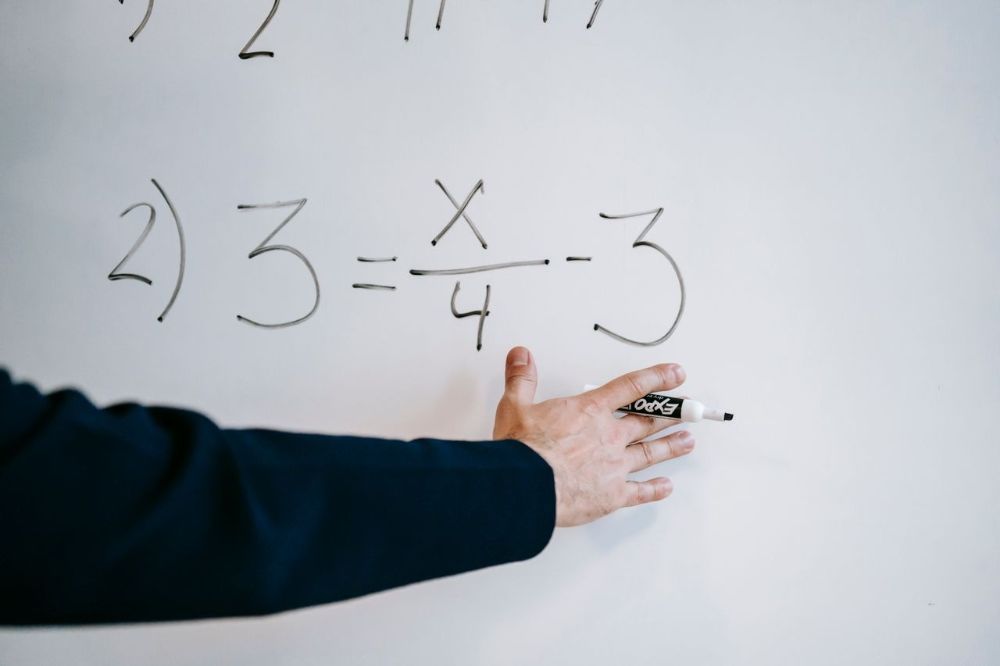
A child can multiply and divide confidently yet struggle to explain why one-third is larger than one-fifth. The difficulty may reveal a misunderstanding that ordinary arithmetic practice has not uncovered.
A Year 6 pupil answers a series of multiplication questions confidently.
Six times eight? Forty-eight.
Seven times nine? Sixty-three.
Twelve divided by three? Four.
Then comes a different question.
Which is larger: one-third or one-fifth?
"One-fifth," the pupil replies. "Because five is bigger than three."
The answer is wrong, but the reasoning reveals something important.
The child has applied a familiar whole-number comparison to fractions, where the relationship works differently.
For parents considering maths tuition in Batley, this is an example of why correct arithmetic does not always demonstrate secure mathematical understanding.
If the misconception remains unresolved, it may create difficulties when the pupil encounters equivalent fractions, percentages, ratio and algebra.
Why Are Fractions Harder Than Whole Numbers?
Children learn early that five is greater than three and eight is greater than six.
These comparisons are correct for whole numbers.
Fractions extend that understanding.
When the same whole is divided into more equal parts, each individual part becomes smaller.
Imagine two identical chocolate bars.
One is divided into three equal pieces.
The other is divided into five equal pieces.
One piece from the first bar represents one-third.
One piece from the second represents one-fifth.
Because both chocolate bars were originally the same size, one-third is larger than one-fifth.
1/3 is greater than 1/5.
The denominator tells us how many equal parts make one whole. It does not, by itself, tell us the value of the fraction.
A pupil who understands this relationship can explain why the comparison works.
A pupil who has memorised a procedure without understanding the relationship may struggle when the question changes.
What Does a Fractions Misconception Look Like?
Consider another question:
Which is larger: 3/4 or 3/8?
A pupil might answer three-eighths because eight is greater than four.
Now imagine two identical pizzas.
One is divided into four equal slices, and three slices are taken.
The other is divided into eight equal slices, and three slices are taken.
Three quarters represents more pizza than three eighths.
Therefore:
3/4 is greater than 3/8.
This illustrates why an incorrect answer should not automatically be dismissed as carelessness.
The pupil may be applying a rule that makes sense to them but does not work in the new situation.
The Education Endowment Foundation (EEF) recommends using assessment to identify misconceptions and understand pupils' mathematical thinking.
Knowing that an answer is incorrect is only the beginning.
The next question is why the pupil reached that answer.
Are Fractions Numbers or Just Pieces of Pizza?
Pictures of pizzas, cakes and chocolate bars can help children understand fractions.
However, fractions are also numbers with positions on the number line.
Consider:
1/2 = 0.5
This lies halfway between zero and one.
3/4 = 0.75
This lies between one-half and one.
5/4 = 1¼
This is greater than one.
Some pupils assume fractions must always represent amounts smaller than one whole.
But fractions can be less than, equal to or greater than one.
Take:
7/4
Four quarters make one whole.
Three quarters remain.
Therefore:
7/4 = 1¾
A child who understands the relationship between quarters and wholes can reason through this conversion.
A child who relies entirely on memorised steps may calculate correctly without understanding what the answer represents.
Number lines help pupils recognise fractions as numbers rather than simply shaded sections of shapes.
Why Does Adding Fractions Cause Confusion?
Consider:
1/4 + 1/4
Some pupils add the numerators and denominators separately.
They calculate:
1 + 1 = 2
4 + 4 = 8
And conclude:
1/4 + 1/4 = 2/8
That is incorrect.
Each fraction represents one quarter.
One quarter plus another quarter equals two quarters.
Therefore:
1/4 + 1/4 = 2/4 = 1/2
The denominator remains four because the size of the parts has not changed.
We are counting quarters.
Imagine a rectangle divided into four equal sections.
Shade one section.
Then shade another.
Two of the four sections are now shaded.
That represents two quarters, not two eighths.
This explanation is more useful than simply telling the pupil to keep the denominator unchanged.
It demonstrates why the method works.
Maths Tuition in Batley: Why Finding the Error Matters
Two children may make the same mistake when adding fractions but need different support.
One may not understand what the denominator represents.
Another may understand the concept but forget the calculation procedure.
A third may have gaps in their understanding of equivalent fractions.
Giving all three pupils identical worksheets may not address their individual difficulties.
At Improve Tuition, established in 2007, teaching focuses on identifying gaps in understanding before selecting suitable practice.
Parents exploring maths tuition in Batley should ask how tutors investigate the reasoning behind incorrect answers.
A useful assessment considers whether the difficulty involves the mathematical concept, the calculation method or applying knowledge to an unfamiliar question.
The important question is not simply:
"Can my child answer this?"
It is:
"Does my child understand why the answer is correct?"
Why Do Equivalent Fractions Matter?
Equivalent fractions are different ways of representing the same value.
For example:
1/2 = 2/4 = 3/6 = 4/8
Imagine a rectangle divided into two equal sections.
Shade one half.
Now divide each section into two smaller equal parts.
There are four equal sections altogether, and two are shaded.
The shaded amount has not changed.
It is still one-half.
This demonstrates why multiplying the numerator and denominator by the same non-zero number produces an equivalent fraction.
For example:
2/3 = 4/6
The numerator and denominator have both been multiplied by two.
The value remains unchanged.
Understanding this relationship is essential when pupils begin adding and subtracting fractions with different denominators.
How Do You Add Fractions with Different Denominators?
Consider:
1/2 + 1/4
The fractions represent parts of different sizes.
Before adding them, we express them using equal-sized parts.
One-half is equivalent to two quarters.
Therefore:
1/2 = 2/4
Now the calculation becomes:
2/4 + 1/4 = 3/4
The answer is three-quarters.
The method becomes easier to understand when the pupil recognises why the parts must first be expressed using a common denominator.
A procedure supported by understanding is more likely to be applied appropriately when questions become unfamiliar.
Do Diagrams and Number Lines Always Help?
Visual representations can help pupils understand mathematical relationships.
Fraction strips, number lines and diagrams can make abstract ideas easier to examine.
However, pictures are not automatic solutions.
Their effectiveness depends on how they are used.
For example, a fraction strip can demonstrate why two quarters are equivalent to one-half.
A number line can show that five quarters is greater than one.
But pupils should gradually learn to explain these relationships without relying entirely on the pictures.
The EEF's guidance on improving mathematics in Key Stages 2 and 3 emphasises the purposeful use of manipulatives and representations alongside mathematical explanation.
The aim is not simply to complete a calculation with a diagram.
It is to understand the mathematical relationship the diagram represents.
Why Can Fraction Difficulties Continue into Secondary School?
Fractions form part of a wider network of mathematical knowledge.
At Key Stage 3, pupils encounter fractions in proportional reasoning, algebra, probability and increasingly complex calculations.
At GCSE, they may need fractional understanding when rearranging equations, interpreting ratios and solving probability problems.
This is why GCSE maths tuition in Batley may sometimes involve revisiting concepts first introduced during primary school.
Consider:
Three-quarters of a number is 24. What is the number?
A pupil might calculate:
24 × 4 ÷ 3 = 32
That method works.
But can they explain why?
Three quarters represent 24.
Therefore, one quarter represents:
24 ÷ 3 = 8
Four quarters represent:
8 × 4 = 32
Answer: 32
The second explanation demonstrates how the calculation follows from the meaning of the fraction.
This reasoning becomes increasingly important as mathematical problems become more demanding.
Do Times Tables Still Matter?
Yes.
Secure multiplication and division facts remain important when working with fractions.
Consider simplifying:
18/24
Both 18 and 24 are divisible by six.
Dividing the numerator and denominator by six gives:
18/24 = 3/4
A pupil who recalls multiplication and division facts confidently may complete this calculation more efficiently.
However, recalling the facts is only part of the task.
The pupil should also understand why dividing the numerator and denominator by the same non-zero number preserves the fraction's value.
Arithmetic fluency and conceptual understanding work together.
Neither should be neglected.
Five Questions Parents Can Ask About Fractions
Parents can investigate their child's understanding through short conversations rather than lengthy tests.
1. Which Is Larger: 1/3 or 1/5? Why?
Look for an explanation that the same whole has been divided into different numbers of equal parts.
2. Is 2/4 the Same as 1/2?
Ask your child to demonstrate the relationship using a diagram or explanation.
3. What Does 7/4 Mean?
Can your child explain that seven quarters represent one whole and three quarters?
4. Why Is 1/4 + 1/4 Equal to 2/4 Rather Than 2/8?
This can reveal whether your child understands what the denominator represents.
5. Is 3/4 of 20 Greater Than or Less Than 20?
The answer is less than 20 because three-quarters represents less than one whole.
These questions are useful starting points for understanding mathematical thinking.
They are not a substitute for a formal assessment.
What Should Parents Ask a Maths Tutor in Batley?
Parents comparing maths tutors in Batley should look beyond the number of worksheets completed.
A useful tutor should investigate whether the pupil's difficulty lies in number knowledge, understanding mathematical concepts, calculation procedures or applying methods.
For fractions, parents might ask:
- How will you identify my child's misconceptions?
- Will you use diagrams or number lines to explain difficult concepts?
- How will you check whether my child understands the method?
- Will my child practise unfamiliar questions?
- How will you assess progress towards independent problem-solving?
Some pupils need additional practice.
Others need a different explanation or support with an earlier topic.
The appropriate approach depends on what the pupil already understands.
Frequently Asked Questions
Why Does My Child Know Their Times Tables but Struggle with Fractions?
Times tables develop fluency with multiplication and division. Fractions introduce additional relationships involving parts, wholes and equivalent values. A pupil may be confident with arithmetic but still misunderstand these concepts.
How Can I Tell Whether My Child Has a Fractions Misconception?
Ask your child to explain their reasoning rather than simply provide an answer. For example, ask why one-third is larger than one-fifth when comparing equal-sized wholes.
Do Fraction Difficulties Affect GCSE Maths?
They can. Fractions underpin important areas of GCSE Maths, including ratio, proportion, algebra and probability. Gaps in earlier understanding may make these topics more difficult.
Where Can I Find Maths Tuition in Batley?
Improve Tuition provides Maths support at its Batley centre, including primary Maths, SATs, 11+, Key Stage 3, GCSE and advanced study. Online tuition is also available.
Does Improve Tuition Also Teach English and Science?
Yes. Improve Tuition provides Maths, English and Science tuition for children and young people aged 6–18.
The Question That Reveals More Than a Correct Answer
A child completes a fraction calculation and gives the correct answer.
That is encouraging.
But there is another question worth asking:
"Can you explain why that works?"
A pupil who can explain why one-third is larger than one-fifth has demonstrated more than recall.
A pupil who understands why equivalent fractions represent the same value has developed knowledge that supports later calculations.
And a pupil who recognises when an answer is unreasonable is beginning to check their own mathematical thinking.
These are important foundations for more advanced mathematics.
The goal is not simply to teach children how to calculate with fractions. It is to help them understand what fractions actually mean.
Maths Tuition in Batley — Improve Tuition
Improve Tuition, established in 2007, provides Maths, English and Science tuition for children and young people aged 6–18.
Its Maths support includes primary mathematics, SATs preparation, 11+, Key Stage 3, GCSE Maths and advanced study.
Teaching focuses on identifying learning gaps, explaining mathematical concepts and helping pupils apply their understanding independently.
Improve Tuition offers face-to-face tuition at its Batley centre and live online lessons.
Families in Batley and surrounding areas, including Dewsbury and Ravensthorpe, can enquire about suitable support.
Looking for a maths tutor in Batley?
Visit our Maths tutor in Batley page or contact Improve Tuition to discuss your child's learning needs.
Looking for Maths Support in Batley?
Contact Improve Tuition to discuss your child's learning needs.
Book a Free Initial Assessment