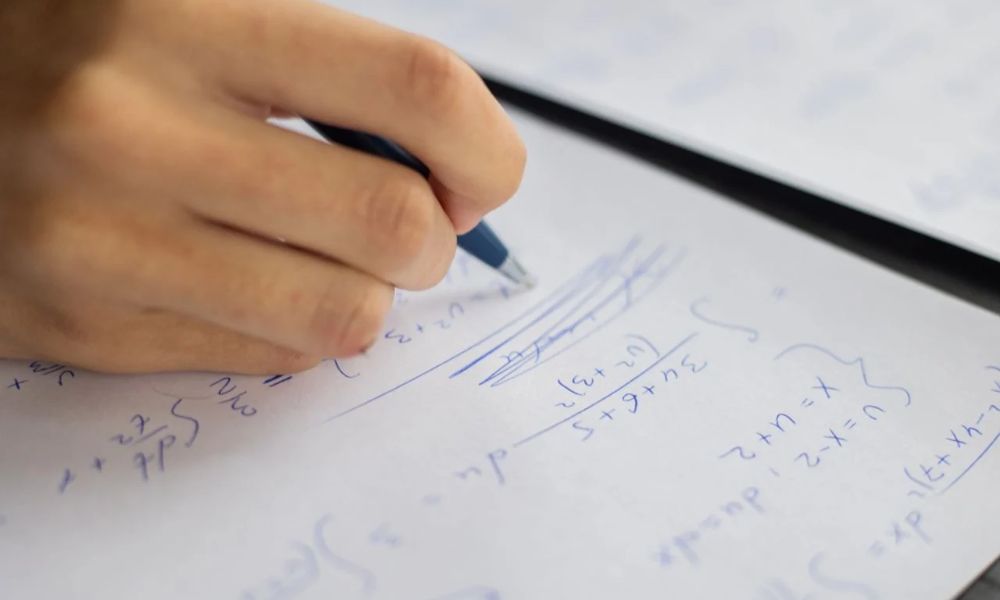
A Year 11 pupil completes a GCSE Maths past paper, checks the answers and circles the questions they got wrong.
The following evening, they complete another paper.
A week later, they sit a mock examination. Despite all the revision, their marks have barely changed.
For parents considering GCSE maths tuition in Batley, this is a familiar concern. Their child is working hard, spending time revising and completing examination questions, yet the improvement they hoped for has not materialised.
It is tempting to assume that the solution is another ten past papers.
But what if the problem is not how many questions the pupil completes?
What if the difficulty lies in understanding the mathematics behind those questions?
Past papers are an important revision resource. However, their effectiveness depends on how they are used, what pupils already understand and whether mistakes lead to meaningful changes in learning.
Why GCSE Maths Tests More Than Remembering Methods
GCSE Mathematics is designed to assess more than the ability to repeat familiar calculations.
The examination requirements include three broad areas:
- AO1 — Using standard mathematical techniques: recalling knowledge and carrying out mathematical procedures.
- AO2 — Mathematical reasoning: interpreting information, explaining methods and drawing conclusions.
- AO3 — Problem-solving: selecting and applying mathematical knowledge in different contexts.
These assessment objectives are set nationally and apply across GCSE Maths examination boards.
For AQA GCSE Maths, reasoning and problem-solving together account for approximately 50% of the Foundation assessment and 60% of the Higher assessment.
This has an important implication for revision.
A pupil who can remember a method but cannot recognise when to use it may struggle to demonstrate their understanding across the examination.
The challenge is not always calculating the answer.
Sometimes, the hardest part is deciding where to begin.
One Mathematical Skill, Two Very Different Questions
Consider the following example.
Question 1
Solve:
3x + 5 = 20
A pupil who has practised solving equations may immediately recognise the method.
Subtract 5 from both sides:
3x = 15
Divide both sides by 3:
x = 5
Now consider a different question.
Question 2
A taxi company charges a fixed booking fee of £5 and £3 for every mile travelled.
A journey costs £20.
How many miles was the journey?
The pupil must first recognise that the problem can be represented by an equation.
Let x represent the number of miles.
3x + 5 = 20
Solving gives:
x = 5 miles
The mathematics is identical.
Yet the second question demands an additional skill: translating written information into a mathematical relationship.
A pupil might answer the first question confidently but struggle with the second.
That does not necessarily mean they have forgotten algebra.
They may need help recognising how algebra applies to real situations.
A tutor who simply assigns more equations may miss the actual difficulty.
The pupil may need teaching that connects mathematical language, real-life contexts and algebraic reasoning.
The Hidden Problem with Repeated Past Papers
Completing examination papers can reveal weaknesses.
But identifying a weakness is not the same as correcting it.
Imagine a pupil repeatedly loses marks on ratio questions.
They complete one past paper and get a ratio question wrong.
They check the mark scheme, copy the correct answer and move on.
A few days later, another ratio question appears.
Again, they struggle.
The pattern continues because the original misunderstanding has not been addressed.
Perhaps the pupil does not understand what a ratio represents.
Perhaps they cannot divide a quantity into proportional parts.
Or perhaps they understand straightforward ratio questions but struggle when the information is presented in words.
These are different problems requiring different explanations.
A mark scheme can show what the correct answer is. It does not always explain why a particular pupil arrived at the wrong one.
That is why effective GCSE revision should include investigating mistakes, not simply recording them.
GCSE Maths Tuition in Batley: Finding the Reason Behind Lost Marks
At Improve Tuition, established in 2007, the starting point for Maths support is identifying what a pupil understands and where difficulties begin.
This is particularly important when preparing for GCSE examinations.
Two pupils may achieve the same mark on a practice paper for entirely different reasons.
One may struggle with fractions, percentages and basic arithmetic.
Another may understand those topics but find multi-step word problems difficult.
A third may have sufficient mathematical knowledge but make frequent errors when working under time pressure.
Giving all three pupils identical revision worksheets may not be the most effective response.
A more focused approach investigates the cause of the mistakes before deciding which topics and methods require attention.
For parents exploring maths tuition in Batley, this is an important question to ask: does the teaching begin with an assessment of the pupil's actual difficulties?
Why Reading Comprehension Matters in GCSE Maths
Parents sometimes find it surprising that reading skills can affect Maths performance.
But GCSE questions frequently require pupils to interpret written information before performing calculations.
Consider this question:
A shop increases the price of a jacket by 20%. The original price was £60. Calculate the new price.
The pupil needs to recognise that an increase means adding an amount to the original price.
20% of £60 = £12
£60 + £12 = £72
New price: £72
Now change one word.
A shop decreases the price of a jacket by 20%.
The calculation of 20% remains the same.
But the final operation changes.
£60 − £12 = £48
New price: £48
A pupil who calculates £12 correctly in both questions but gives the wrong final price may have difficulty interpreting the language rather than calculating the percentage.
Words such as increase, decrease, difference, total, remaining, proportional and estimate carry important mathematical meanings.
Teaching pupils to recognise these meanings can be just as important as practising calculations.
Why Memorising Formulas Is Not Enough
Formulas are important in GCSE Mathematics.
Pupils need to recognise mathematical relationships and use them accurately.
But memorising a formula does not guarantee that a pupil understands when it applies.
Consider the area of a circle:
Area = πr²
A pupil may remember this formula perfectly.
But can they identify the radius when a question provides the diameter?
Can they distinguish area from circumference?
Can they explain why the answer is measured in square centimetres rather than centimetres?
These details matter.
A pupil who knows the formula but confuses diameter and radius may lose marks even though their calculation is otherwise correct.
For example, a circle has a diameter of 10 cm.
Its radius is 5 cm.
Area = π × 5²
Area = 25π cm², approximately 78.5 cm².
Using 10 as the radius would produce an incorrect answer.
The mistake is not necessarily a failure of multiplication or squaring.
It may be a misunderstanding of the information provided.
Effective teaching identifies precisely where the reasoning breaks down.
What Should Pupils Do After Completing a Past Paper?
A completed paper should be the beginning of a useful revision process, not simply another score to record.
Parents can encourage their children to examine mistakes more carefully.
A practical approach involves five stages.
1. Identify the question that caused difficulty
Record the topic and what the question required.
2. Work Out Why Marks Were Lost
Was the problem missing knowledge, an incorrect calculation, misunderstood wording or poor examination technique?
3. Revisit the Underlying Skill
Use a clear explanation and a few carefully chosen examples to address the difficulty.
4. Attempt a Similar but Different Question
This checks whether the pupil can apply the method rather than merely copy the original solution.
5. Return to the Topic Later
Revisit the skill after a suitable interval to check whether the learning has been retained.
This approach helps turn past papers from a method of measuring performance into a tool for improving understanding.
Foundation and Higher GCSE Maths: Different Demands, Same Principles
GCSE Maths is offered at Foundation and Higher tiers.
Foundation tier provides access to grades 1–5, while Higher tier provides access to grades 4–9.
Both tiers require pupils to use mathematical knowledge, reason and solve problems.
However, the balance of assessment demands differs.
At Higher tier, a greater proportion of marks is allocated to mathematical reasoning and problem-solving.
This makes flexible understanding particularly important.
A pupil preparing for Higher GCSE Maths may need to connect algebra, geometry, trigonometry and other topics within unfamiliar questions.
A Foundation pupil also needs secure mathematical reasoning, particularly when interpreting practical problems and completing multi-step calculations.
For parents considering a GCSE maths tutor in Batley, the appropriate teaching should reflect the pupil's current understanding, examination tier and specific learning needs.
How Parents Can Tell Whether Revision Is Working
Improvement is not always immediately visible in a headline examination grade.
Parents can look for smaller but meaningful changes.
Can the pupil now complete questions they previously avoided?
Can they explain why a method works?
Are repeated mistakes becoming less frequent?
Can they solve a similar problem when the wording changes?
Do they recognise when an answer is unreasonable?
These developments may indicate that understanding is becoming more secure.
However, parents should also monitor school assessments and examination practice over time.
One successful homework session does not guarantee a particular GCSE grade.
Equally, one disappointing mock result does not necessarily mean that further progress is impossible.
The important question is whether the pupil's difficulties are being identified and addressed systematically.
Choosing Between Batley Maths Tutors
Parents looking for Batley maths tutors often begin with one concern: their child needs to improve their GCSE Maths result.
But before deciding on a tuition programme, it is worth asking how the tutor will establish what is preventing progress.
Does the tutor examine earlier mathematical knowledge?
Do lessons address the pupil's particular misconceptions?
Is the pupil encouraged to explain their thinking?
Are unfamiliar questions introduced gradually?
Is progress checked through independent work?
These questions help parents distinguish between simply completing additional exercises and receiving teaching that addresses individual learning needs.
Improve Tuition offers an initial Maths assessment before recommending tuition, helping identify the areas that require attention.
Its GCSE Maths support includes Foundation and Higher topics, examination preparation and developing mathematical understanding.
The Questions Parents Should Ask After Every Revision Session
Rather than asking only how many questions their child completed, parents can ask:
"What can you do now that you could not do before?"
The answer might be that the pupil finally understands how to divide a quantity in a ratio.
It might be that they can recognise when to use Pythagoras' theorem.
Or it might be that they can read a word problem and identify the mathematical operation without being prompted.
These are meaningful steps towards greater independence.
Past papers remain an essential part of GCSE preparation.
But their greatest value comes when pupils use them to identify weaknesses, revisit difficult concepts and develop the confidence to approach unfamiliar problems.
The goal is not simply to practise more questions. It is to become better at solving questions that have never been seen before.
GCSE Maths Tuition in Batley — Improve Tuition
Improve Tuition provides Maths, English and Science support for children and young people aged 6–18, with GCSE Foundation and Higher Maths tuition available at its Batley centre and online.
Established in 2007, Improve Tuition offers a free initial Maths assessment to help identify learning gaps before recommending suitable support.
Families considering GCSE Maths tuition in Batley can find further information through our Maths tuition service or contact Improve Tuition.